Is Wordpress a good choice for a veterinary website?


WordPress is a free website-building software that’s been around since 2003.

It’s the market leader – around 45% of the world’s websites are built on it.

And it’s the only platform we use for building websites at Specialist Vet Marketing.

In this article, we discuss the suitability of WordPress for veterinary websites by considering

  • Website and marketing results
  • Future-proofing of your asset and
  • Ownership and control.

Website and marketing results


If you’re the only vet in a small outback town, it doesn’t matter much what your website looks like or how fast it loads. You’ve got a captured market.

However, in any urban or semi-urban region of Australia, the veterinary digital marketing landscape is increasingly fiercely competitive.

Your website must look and feel fantastic. It must be professional. It must to load fast and be easy to navigate on phones, tablets and laptops.

It must rank well on Google – there’s no use in having a great-looking website that no one can find.

And finally, it must be unique. Your veterinary business needs to stand out from the crowd. Potential clients need to feel connection and trust and know that you care if they are to pick up the phone and call your practice.

No website operating system comes even close to WordPress for allowing marketers to build vet websites that cover all these bases.

The fact that WordPress is free and open source is a huge added bonus.

At Specialist Vet Marketing, we design and build a unique theme for your WordPress veterinary website that ensures your site genuinely reflects your clinic and stands out from the crowd.

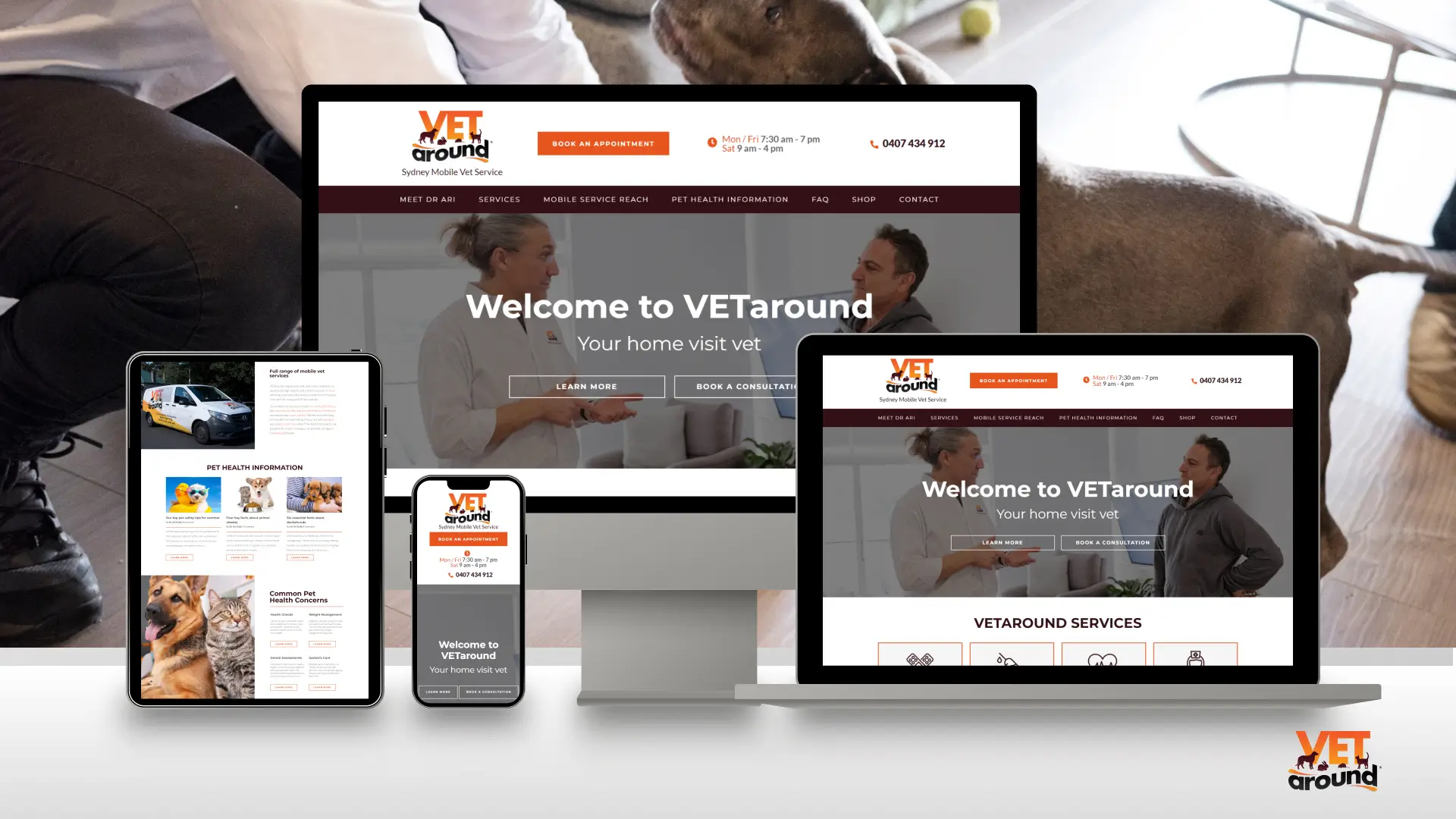
VETaround mobile veterinary website designed by SVMG displayed across desktop, tablet and mobile devices for veterinary digital marketing and client engagement.

As future-proof as it gets


Consider for a moment iPhone, Google Chrome and your laptop’s operating system.

How often are new versions coming out? It feels to me like every 5 minutes.

Veterinary websites are very vulnerable to these updates.

Every time a new iPhone comes out or Google changes its ranking system, your website has to evolve to keep up.

And by keeping up, I mean your vet website has to

  • Continue to rank on Google
  • Display properly on every device and
  • Stay secure from the ever-increasing hack attacks.

As I mentioned before, WordPress is the market leader, with around 470 million websites built on it at the time of writing this article.

It is maintained by a fanatical community that upgrades it every few weeks to keep pace with the rapidly changing digital environment.

It’s as future-proof as you can get in today’s website world.

At Brilliant Digital and now Specialist Vet Marketing, we’ve been building websites on WordPress for over 15 years.

We focus heavily on ensuring our client’s websites last as long as possible before needing to be refreshed.

With a future-proof design strategy, careful maintenance and regular updates, we have WordPress websites in our portfolio that are over ten years old and still delivering business day in and day out.

Control, usability and ownership


And finally, let’s talk about control, usability and ownership.

Control means you own your website.

You choose where it’s hosted and who works on it. You and your team can easily make changes if you want. And you can easily change providers without losing any assets if you wish.

If your WordPress website is coded by a reputable vet marketing company, you will own it outright.

It will be easy to log in and make changes without coding knowledge.

Because it’s open-source, free software, any website developer will be able to work on it in the future – so you are never tied to one specific provider.

Finally, your assets (images, PDFs and content) will be uploaded to your domain and will remain under your control.

Meet the Author

Deb Croucher

Deb Croucher is the founder of SVMG, a strategic growth partner for veterinary businesses. A former veterinarian and practice owner, Deb combines industry fluency, commercial strategy, and structured marketing systems to help clinics, specialists, suppliers, and industry partners become clearer, more trusted, and better positioned for growth.

Learn More  

Frequently Asked Questions

Find answers to common questions about our clinic and your pet’s visits below.

A veterinary growth system brings structure to the parts of marketing that often operate separately: positioning, content, search, campaigns and reporting. SVMG operates that system end-to-end, so activity is not just happening, it is connected, measurable and aligned with how the veterinary market actually makes decisions.

Most agencies deliver services in separate pieces: a website, campaign, content plan or ads. SVMG works at the system level, taking ownership of how those pieces connect, perform and support long-term visibility, positioning and growth.

Yes. Veterinary practices and industry partners operate differently, so the system needs to reflect the audience, decision process and commercial reality of each business. For clinics, that may mean attracting better-fit clients and protecting position; for industry partners, it may mean improving visibility, sales support and market response.

In most cases, disjointed marketing is not caused by a lack of effort. It happens when activity is spread across channels without a clear structure behind it. That’s where bringing everything into one connected system changes how the business is understood and how it performs.

Search is shifting from broad keywords to more specific, question-led queries across Google and AI tools. SVMG builds search and content into the system, so veterinary businesses are easier to find, easier to understand and better positioned when the right clients, clinics or decision-makers are actively looking.

Yes, especially if the activity is there but the direction is unclear. What typically happens is marketing exists across websites, content, social, email or ads, but no one is owning how it all works together. SVMG steps in where structure, accountability and stronger market alignment are needed.