How can I improve my vet clinic's ranking on Google?


25 years of marketing veterinary practices online have taught me that organic, free Google search consistently delivers the best return on investment for the vast majority of clinics.

However, becoming the leader of the pack on page one of Google is not easy in today’s crowded and noisy online world.

When I talk to vets about what they understand about SEO (Search Engine Optimisation) and how it relates to their practice, they usually mention keywords and some kind of magic manipulation that SEO experts do with their websites.

Actually, just like with veterinary medicine, there’s no magic (other than perhaps the healing power of cats…)

So, if you are paying for keyword manipulation and link building by SEO experts month in and month out, please stop.

Most of this activity is a waste of cash.

Just like becoming a great vet requires consistent, skilled effort over time, successful Google optimisation of vet websites comes from consistent, skilled and strategic effort over time.

Your vet marketing team needs to focus on 3 key areas if you are to climb the Google rankings successfully and enjoy new clients coming from free searches.

Correct set-up and structure of your website
Google Business Profile (Local Search)
Adding more content to your correctly set up website

In this article, I look at each of these key areas and explain where to invest for best results.

1. Vet website set up and structure


Let’s talk about what makes a website rank (or not) on Google.

If you want some bedtime reading, here’s the Google guide to search engine optimisation.

We’ve followed this guide religiously since the first version appeared in 2008 (the same year I launched digital marketing company Brilliant Digital). And the results for our many hundreds of clients speak for themselves.

I love the fact that this guide is written by Google – not by someone who has a vested interest in manipulating keywords or building backlinks.

And if you don’t want to read every word, here’s a summary.

In your consulting room, you have two ‘patients’ to deal with: your actual patient and their owner.

Getting your website to rank on Google also requires that you focus on two audiences.

The first audience is Google bots

Your website must be set up for correctly for Google, or it will never rank. In terms of the technical set-up and structure, pitfalls to avoid are:

  • Failing to follow the Google Guide to SEO
  • Failing to weave carefully planned SEO into the website from day one
  • Off-the-shelf templates and themes
  • Drag and drop website builders (like Elementor) that clog your site with spammy code
  • Afterthought websites tacked onto operating systems

I cannot stress strongly enough that your initial vet website investment is super important. Invest in a decent website, and it will last you for years and pay you back in spades.

Go cheap, and you will go backwards.

The second audience is people

Once your website is set up correctly for Google, ongoing investment in content that appeals to new and existing clients is the key to climbing the Google rankings.

Google measures how people interact with your website, and this data affects your ranking. If people bounce off your website because it’s boring, unprofessional or poorly designed, your Google ranking goes down.

If they stay on your website and view multiple pages because it’s exactly what they were looking for, your Google ranking goes up.

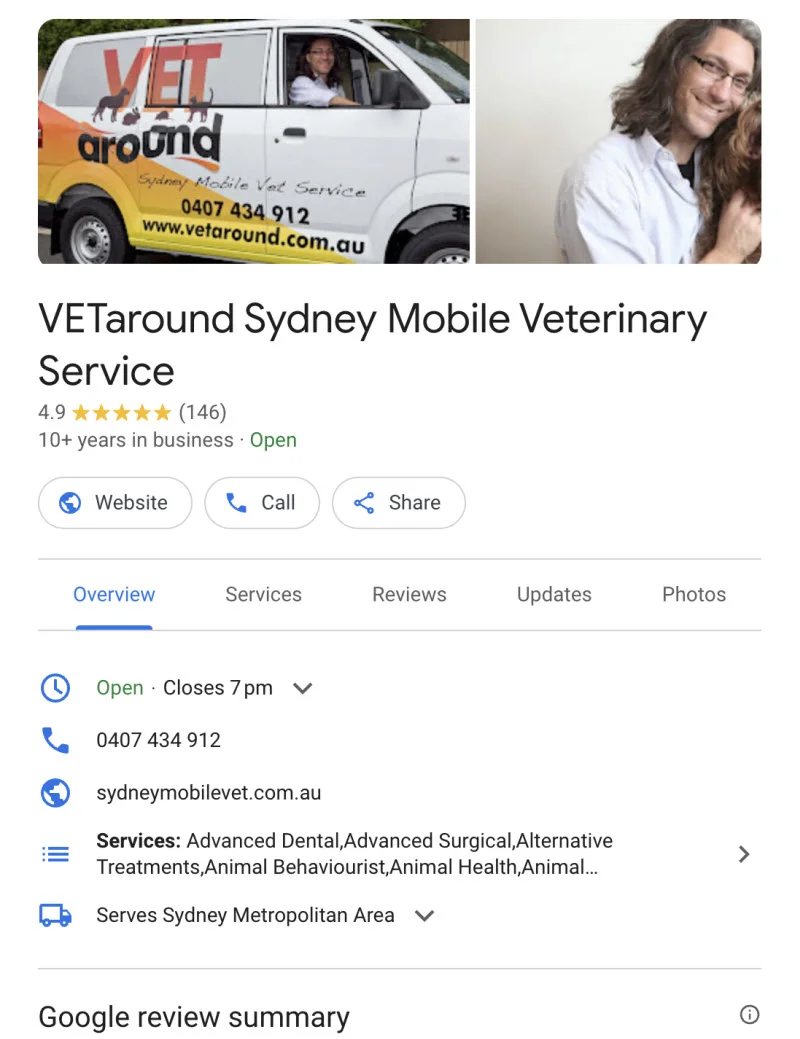
Google Business Profile for VETaround Sydney Mobile Veterinary Service featured in SVMG local SEO and veterinary digital marketing.

2. Google Business Profile


Since most people visit a vet locally, your Google Business Profile is very important.

This is the local business listing you see on the front page of Google when you’re choosing any local service.

Settling up your profile with the required text and images is a fairly easy job – just a couple of hours, and you’re done.

The trick from there is to ask your good clients to post reviews.

This is super important because more and more consumers today rely on reviews as a key part of their decision-making.

The younger your clients, the more important reviews are.

You need a system for collecting reviews, and you need your team to be behind it.

Relying on random reviews is risky because a couple of bad ones can really hurt.

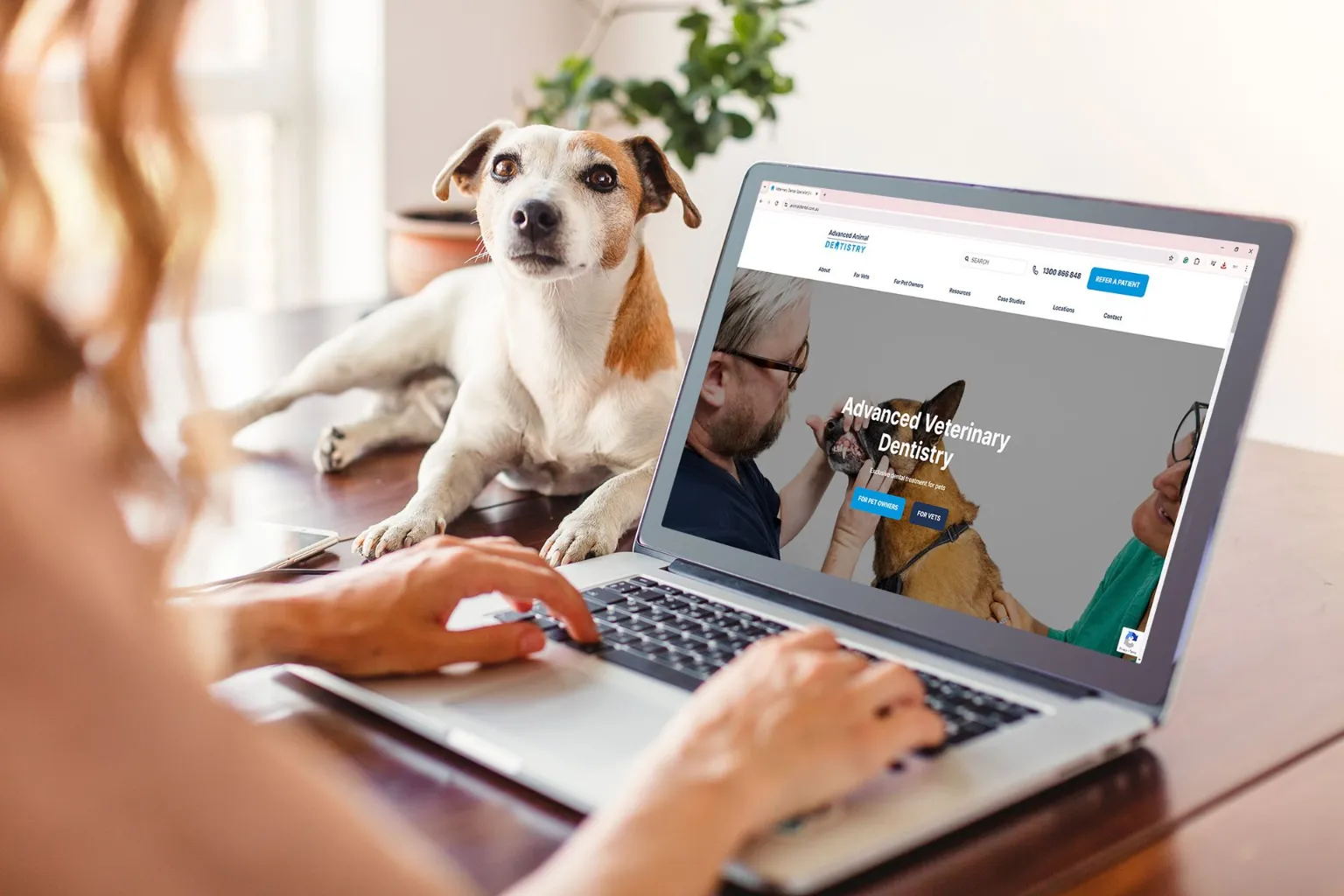
Pet owner browsing a veterinary website beside a dog featured in SVMG veterinary website design and digital marketing.

3. Adding more content to your website


The content on your website is what powers it to rank better and better for more search terms over time.

Ranking for things like ‘what age should I de-sex my kitten’ or ‘what vaccinations does my dog need?’ as well as ‘vet near me’ is very powerful.

If your website comes up in search and people like what they find on your site, there is every chance they’ll use your clinic if you’re local to them.

Google and your market want to see high-quality, original content on your website – and it’s important that you add to that content to appear regularly and consistently in the form of articles, blogs, news and case studies.

Consistent effort over time following a well thought out content marketing strategy is the best way to achieve the results and return you are looking for.

This is particularly important for referral centres where local search is less dominant, and building trust in your knowledge and experience is vital.

Once you have a good veterinary website and your Google local search is set up and humming, your investment should shift to adding content to your website. This is the route to the front of the pack where the gold lies.

Meet the Author

Deb Croucher

Deb Croucher is the founder of SVMG, a strategic growth partner for veterinary businesses. A former veterinarian and practice owner, Deb combines industry fluency, commercial strategy, and structured marketing systems to help clinics, specialists, suppliers, and industry partners become clearer, more trusted, and better positioned for growth.

Learn More  

Frequently Asked Questions

Find answers to common questions about our clinic and your pet’s visits below.

A veterinary growth system brings structure to the parts of marketing that often operate separately: positioning, content, search, campaigns and reporting. SVMG operates that system end-to-end, so activity is not just happening, it is connected, measurable and aligned with how the veterinary market actually makes decisions.

Most agencies deliver services in separate pieces: a website, campaign, content plan or ads. SVMG works at the system level, taking ownership of how those pieces connect, perform and support long-term visibility, positioning and growth.

Yes. Veterinary practices and industry partners operate differently, so the system needs to reflect the audience, decision process and commercial reality of each business. For clinics, that may mean attracting better-fit clients and protecting position; for industry partners, it may mean improving visibility, sales support and market response.

In most cases, disjointed marketing is not caused by a lack of effort. It happens when activity is spread across channels without a clear structure behind it. That’s where bringing everything into one connected system changes how the business is understood and how it performs.

Search is shifting from broad keywords to more specific, question-led queries across Google and AI tools. SVMG builds search and content into the system, so veterinary businesses are easier to find, easier to understand and better positioned when the right clients, clinics or decision-makers are actively looking.

Yes, especially if the activity is there but the direction is unclear. What typically happens is marketing exists across websites, content, social, email or ads, but no one is owning how it all works together. SVMG steps in where structure, accountability and stronger market alignment are needed.