How much does a vet website cost in Australia?


The veterinary website market is more than a little confusing.

You’ll see agencies offering to build websites for anything from $500 to $50,000 and beyond.

Clearly, that’s a massive range—and yes, there are many pitfalls for the uneducated buyer.

How do you make a smart purchasing decision for your vet practice?

In this article, we explore what you can expect from low-cost template websites compared to higher-cost tailored websites.

We also consider how this translates into a return on investment in both the short and long term for rural compared to urban primary care practices and veterinary referral centres.

Vet websites under $5,000


If you’re investing under $5,000, you’re almost certainly buying a templated website.

This means the marketing agency buys a template from the internet on your behalf, or they use a template they’ve used over and over for other vet practices. They then change the colours to match your logo, add text and images, and your new website is ready.

This is a quick process and you can have a presence online fast.

But there are some drawbacks. Here are the key pitfalls of this low-cost, templated type of website.

1. You won’t rank on Google.
Very low-cost websites don’t rank well on Google.

If you are the only vet in a small country town, this might not matter too much.

But if there are many vets in your area, it’s a big problem. There’s simply not enough investment in search engine optimisation (SEO) and content to make your business appear high in the Google search listings for key terms.

See here for a discussion about why free Google search delivers the best return on investment in veterinary marketing.

The only way to drive traffic to these low-cost websites is to pay for advertising and social media, which are expensive and an ongoing drain on your finances.

Also to add insult to injury, advertising and social media are much less effective in attracting the ideal clients you want in your consulting room compared to free Google search.

2. You won’t stand out.
Low-cost template websites have a cookie-cutter approach that your clinic has to ‘slot into’.

This approach does not offer any space for the uniqueness of your vet practice to shine through.

In a crowded marketplace where you have just a few seconds to build trust, if you don’t stand out, the best potential clients will head to the next website.

3. Longevity…
Many of these templated websites are afterthought add-ons to operating systems coded by small companies.

They simply can’t keep up with the accelerating rate of change in phones, laptops, browsers and Google algorithms. (See here for a more detailed discussion on combined vet websites and operating systems).

The end result is that your low-cost vet website will likely need replacing after just a few short years.

Unless you are the only primary care vet in a very small town with no competition, a low-cost website is generally a poor investment.

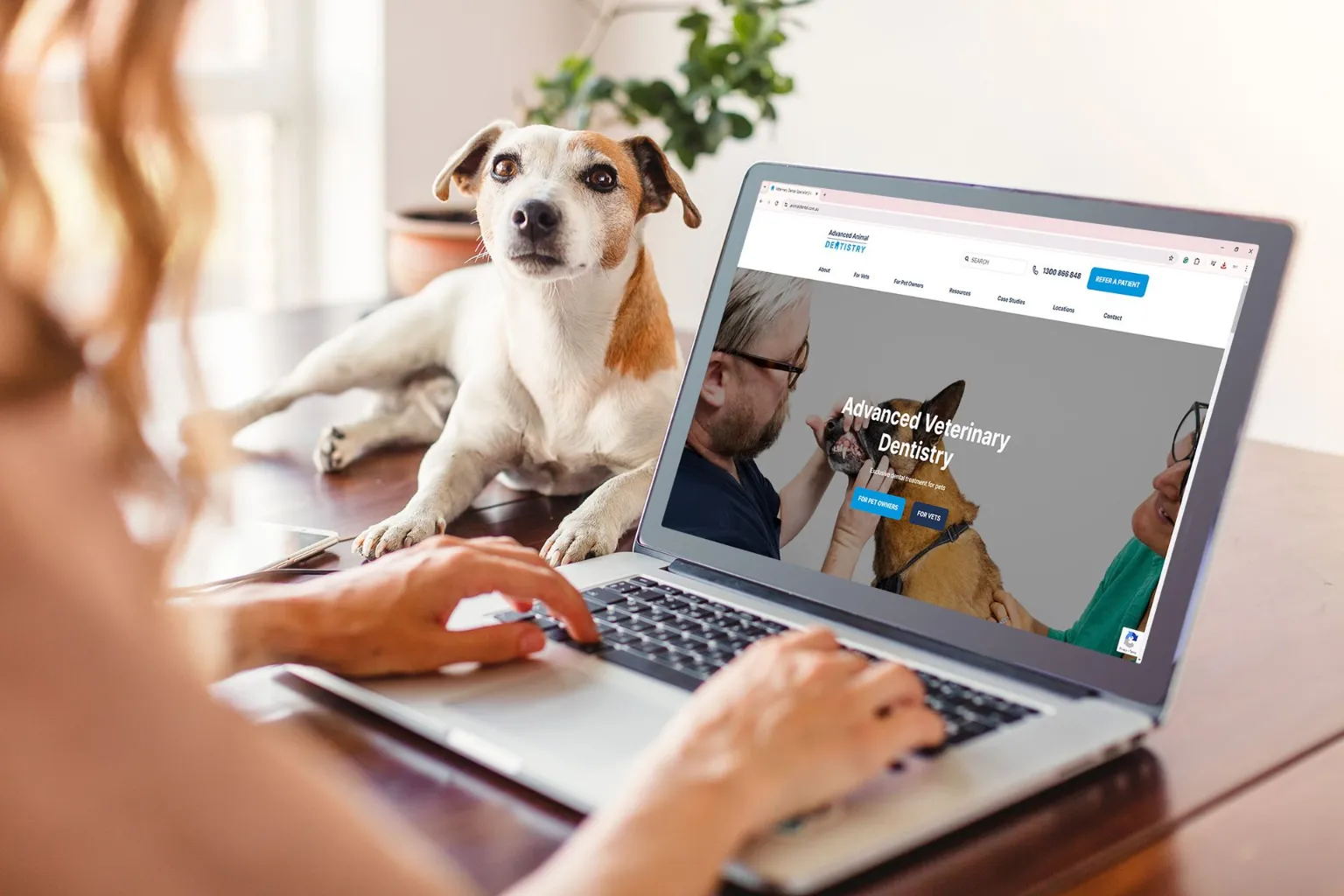
Pet owner browsing a veterinary website beside a dog featured in SVMG veterinary website design and digital marketing.

A unique, tailored website


To stand out in a crowded urban location area or reach referring veterinary colleagues, you need to invest as follows in your vet website:

  • $10,000 or more for a primary care clinic and
  • $15,000 or more for a referral practice

At this level of investment, you should expect:

1. A unique website tailored for your practice.
The marketing agency should have specialist knowledge of the veterinary market. You should see evidence that they are strategic in their approach.

They should take time to audit your existing assets, understand what makes your clinic unique and assess the competition.

In the case of a veterinary referral centre, they should demonstrate that they understand how to structure the website for both pet owners and referring colleagues.

They should produce carefully considered design files that feel exactly right for your practice.

You should expect to see designs for all page types and understand the user flow through the website.

The most flexible and future-proof websites are built on WordPress. See here for more information about WordPress for vet websites.

2. A comprehensive Google search plan.
You should expect detailed keyword research and a plan to build your ranking for a well-thought-out niche on Google.

3. Professionally written content.
To ensure the content is perfect for your ideal client, you should expect to have several conversations with one of the agency’s professional veterinary content writers.

Growing into a high-traffic hub


Larger veterinary websites are information hubs that have high-traffic loads coming from free Google searches.

Once you have invested in a high-quality website, adding more professional content to it gives pet owners and referring vets more information and grows your Google footprint.

Over time, your new website can become a high-traffic hub generating large volumes of enquiry from free Google searches.

At Specialist Vet Marketing, we pride ourselves on building long-term relationships with primary care and referral vets.

Many of our clients started out with websites at investments of $10,000-$15,000.

Then, over time, we worked with them to evolve their websites into powerful, information-rich traffic hubs that deliver millions of dollars worth of new clients every year.

Their websites enjoy longevity, and the practice owners enjoy a superb return on the initial investment.

Meet the Author

Deb Croucher

Deb Croucher is the founder of SVMG, a strategic growth partner for veterinary businesses. A former veterinarian and practice owner, Deb combines industry fluency, commercial strategy, and structured marketing systems to help clinics, specialists, suppliers, and industry partners become clearer, more trusted, and better positioned for growth.

Learn More  

Frequently Asked Questions

Find answers to common questions about our clinic and your pet’s visits below.

A veterinary growth system brings structure to the parts of marketing that often operate separately: positioning, content, search, campaigns and reporting. SVMG operates that system end-to-end, so activity is not just happening, it is connected, measurable and aligned with how the veterinary market actually makes decisions.

Most agencies deliver services in separate pieces: a website, campaign, content plan or ads. SVMG works at the system level, taking ownership of how those pieces connect, perform and support long-term visibility, positioning and growth.

Yes. Veterinary practices and industry partners operate differently, so the system needs to reflect the audience, decision process and commercial reality of each business. For clinics, that may mean attracting better-fit clients and protecting position; for industry partners, it may mean improving visibility, sales support and market response.

In most cases, disjointed marketing is not caused by a lack of effort. It happens when activity is spread across channels without a clear structure behind it. That’s where bringing everything into one connected system changes how the business is understood and how it performs.

Search is shifting from broad keywords to more specific, question-led queries across Google and AI tools. SVMG builds search and content into the system, so veterinary businesses are easier to find, easier to understand and better positioned when the right clients, clinics or decision-makers are actively looking.

Yes, especially if the activity is there but the direction is unclear. What typically happens is marketing exists across websites, content, social, email or ads, but no one is owning how it all works together. SVMG steps in where structure, accountability and stronger market alignment are needed.