We checked 50 vet clinic websites. Here’s what was missing.


One Perth vet clinic’s website features a puppy guide labelled with the name of a clinic in New Zealand. Another still shows its “COVID 19 hours”. A third still has the website builder’s placeholder text on its homepage: “Add your text message to display here.”

Those were the strangest finds in our audit of 50 vet clinic websites across five capital cities. But the bigger story is what was missing.

In our last article, we put AI to the test, asking ChatGPT and Google’s AI Mode to recommend a vet 40 times. Great reviews weren’t always enough. Clinics that clearly explained their services, people and care often stood out. So we checked how many clinic websites do that.

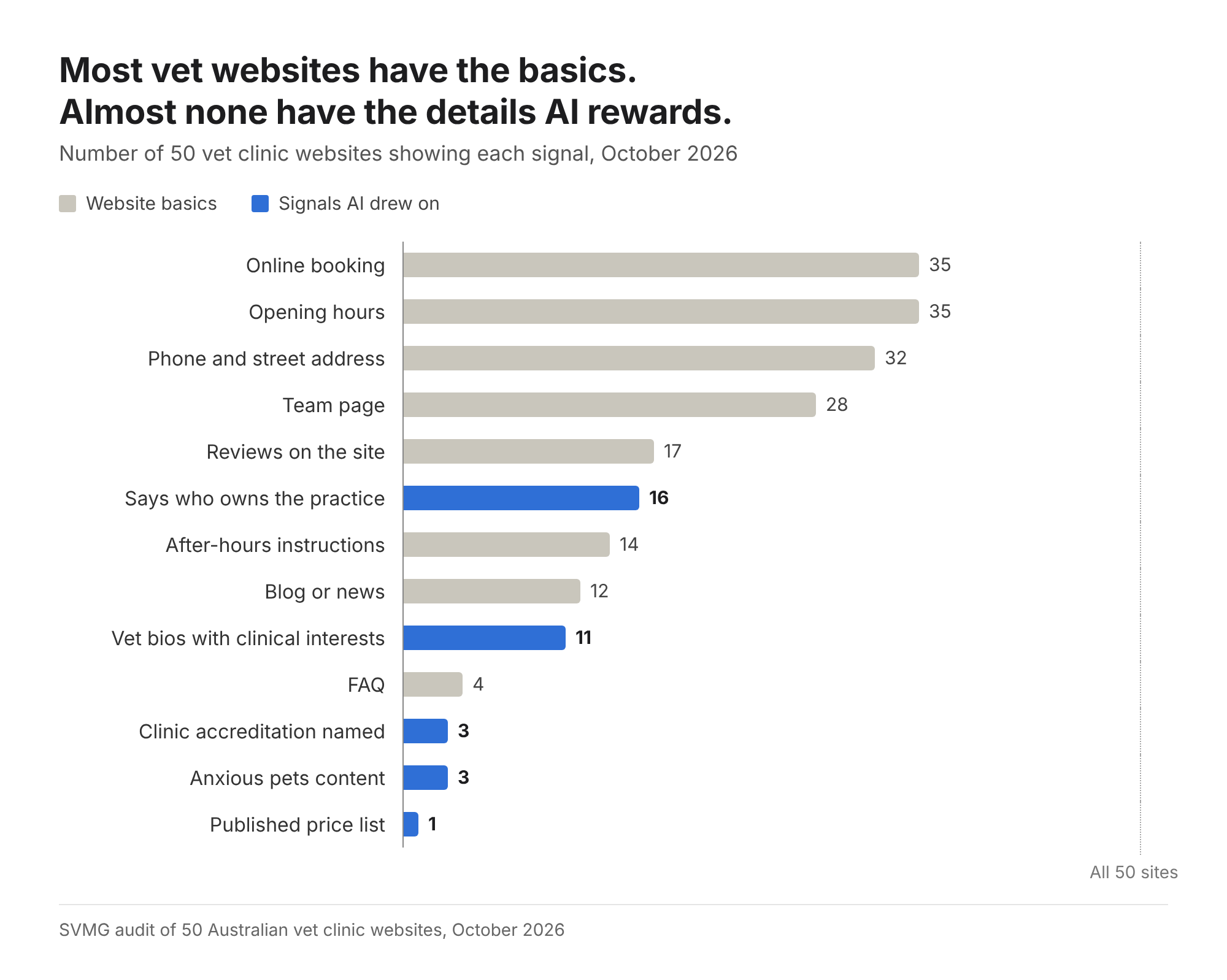
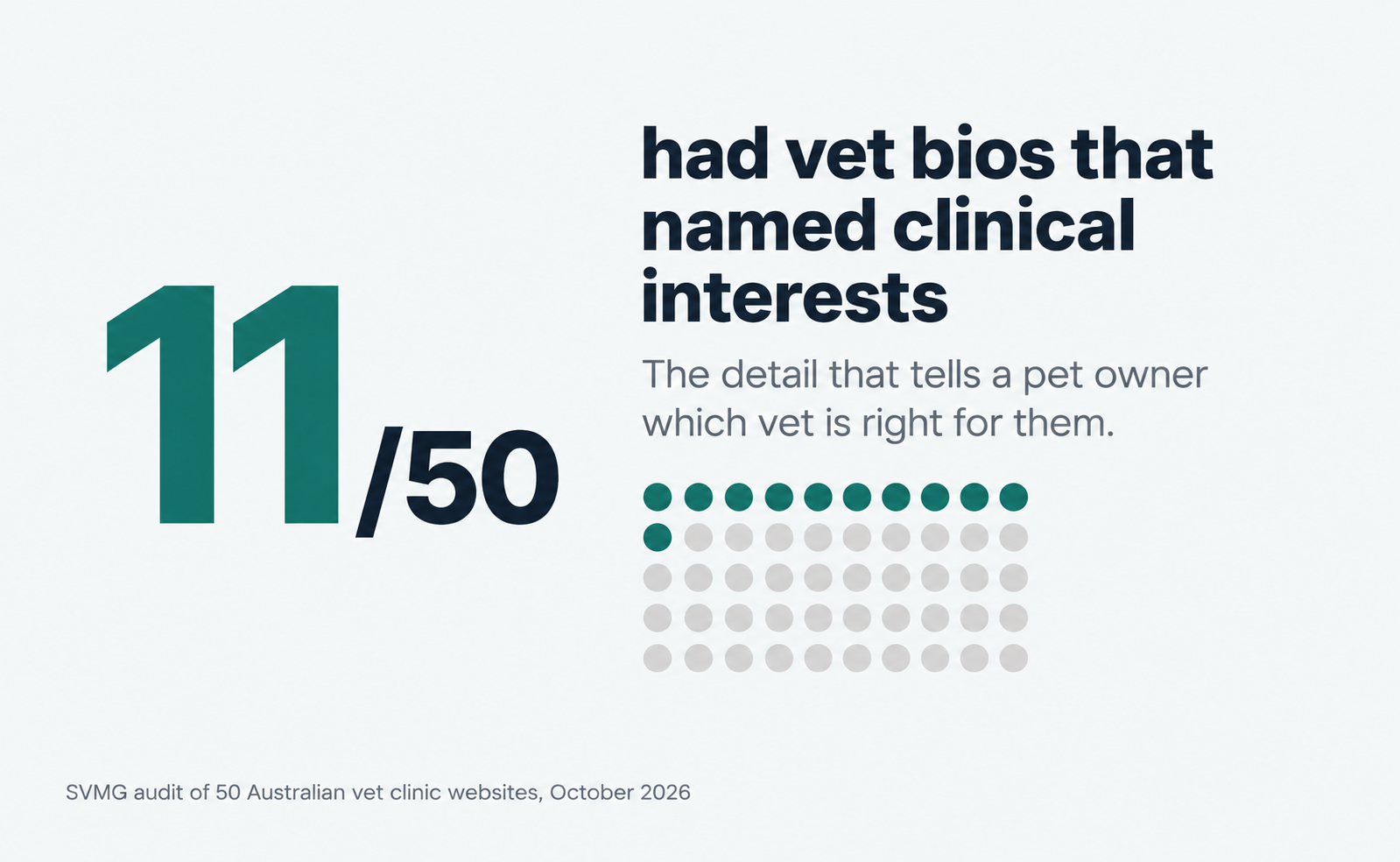
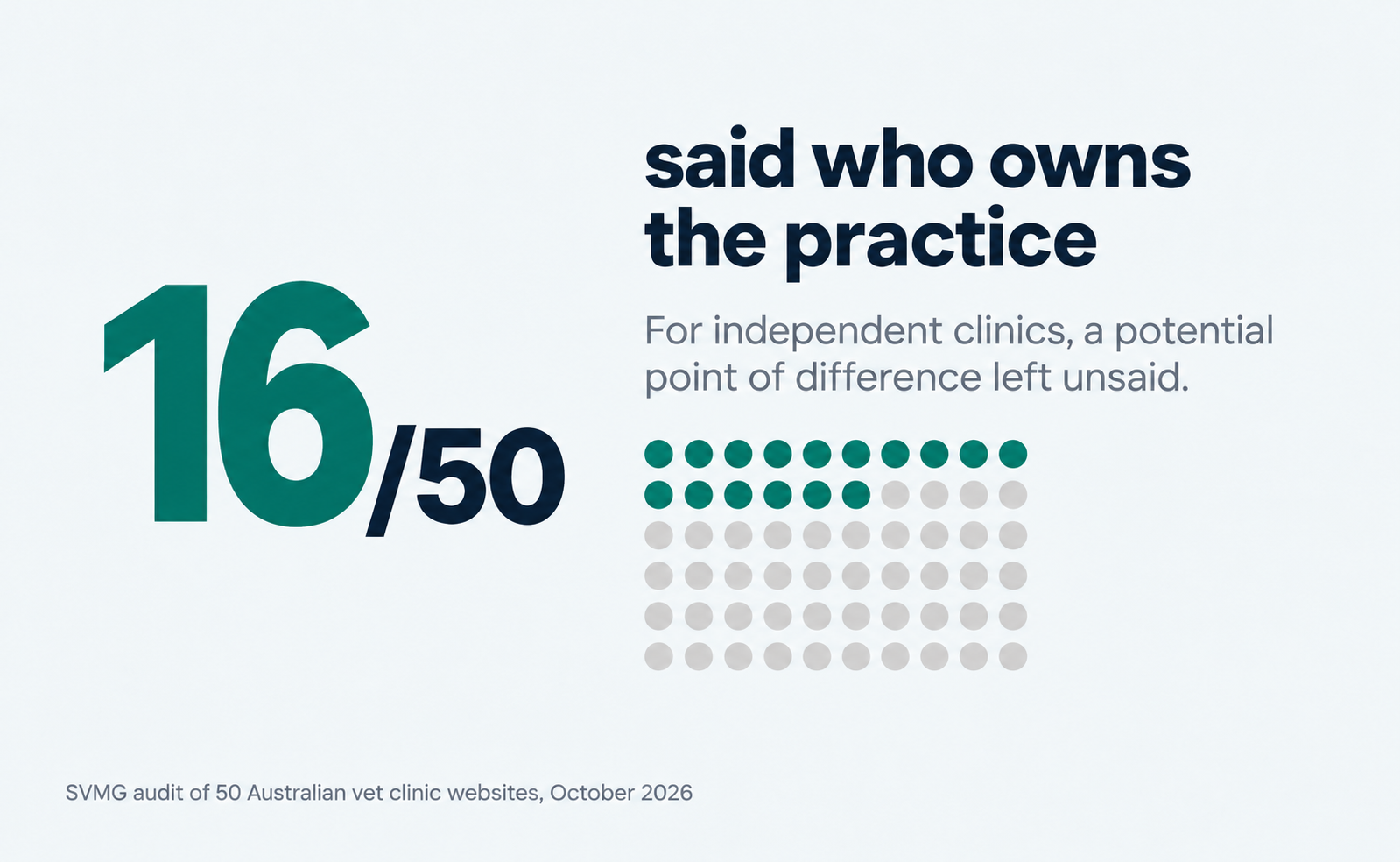
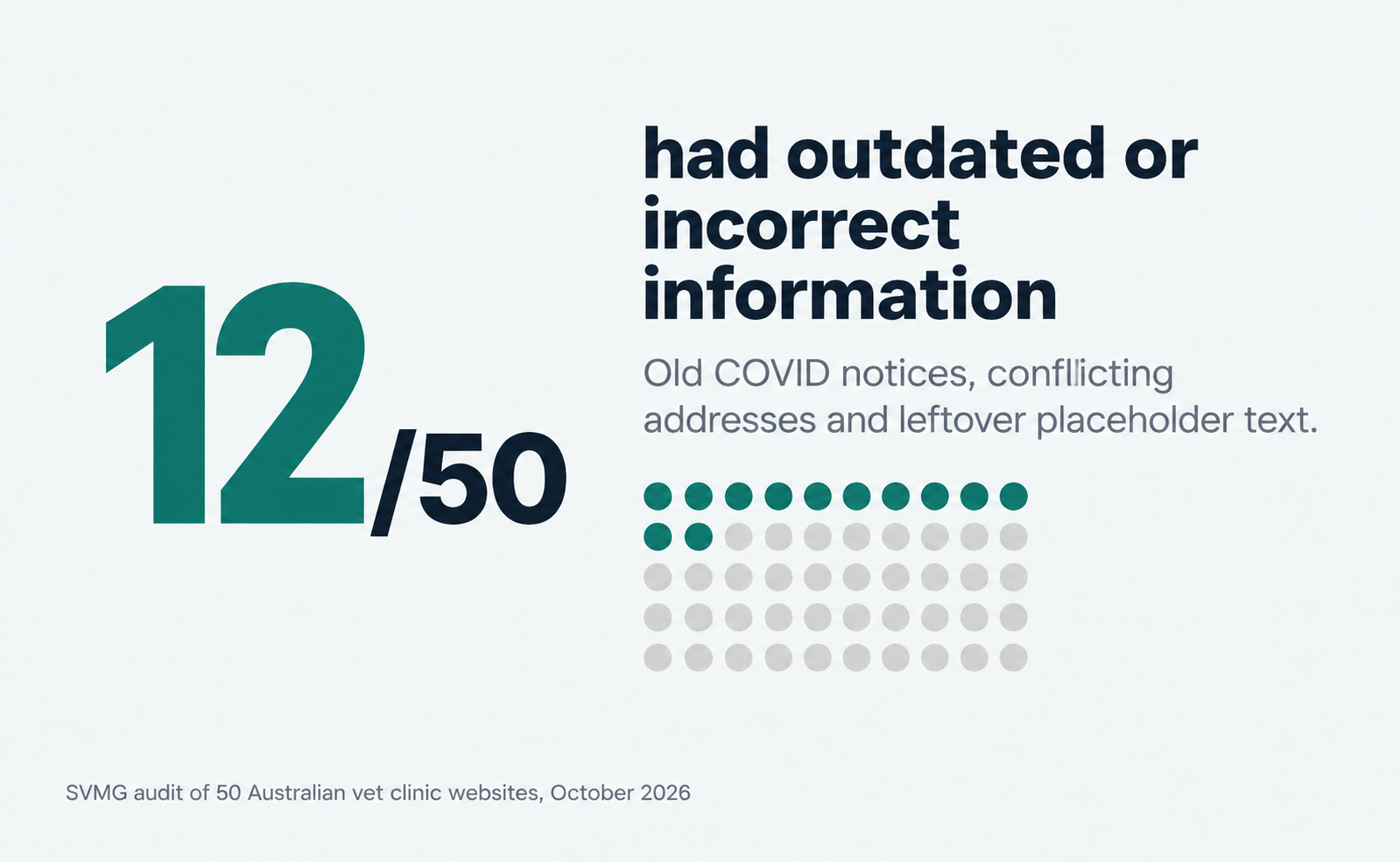
Most don’t. Only 11 of the 50 introduced their vets with the clinical interests that make a pet owner think, “that’s who I want.” Only 16 said who owns the practice. Twelve had something out of date or wrong.

The scorecard: what 50 vet clinic websites showed


Look at where the blue bars sit. The basics, like booking, hours and a team page, are mostly in place. The details that seemed to matter most in our AI experiment cluster at the bottom. Service pages aren’t in the chart, because we couldn’t check them on every site. Of the 41 we could, 23 had at least three.

Your website is only part of the picture, though. Google reviews, local listings and information elsewhere online also influence how pet owners find and assess veterinary clinics. Our experiment showed that reviews still matter, but they don’t always tell the whole story. They work best together.

“A team page without bios is a waiting room with nobody in it.”

Vet team bios: your best asset, hidden in plain sight


In our AI test, ChatGPT didn’t only recommend clinics. It recommended vets by name: “ask for Dr (name), who has an interest in feline medicine.” That detail came straight from team bios.

In this audit, 17 of the 50 websites didn’t name a single vet that we could find. Others listed names and job titles with no bio, a pattern we saw across several group-owned clinics.

Only 11 had bios where most vets stated a clinical interest, such as feline medicine, dentistry, orthopaedics or behaviour. One practice listed ten vets, each with a stated interest. That’s ten reasons for a pet owner, and for AI, to choose them.

A well-planned website doesn’t invent a clinic’s strengths. It finds them and puts them where clients can see them.

Your move: make sure your team profiles show the experience, training and clinical interests that matter most to your clients. Your people are one of your biggest points of difference, so give pet owners a reason to get to know them.

Are your most valuable services getting the attention they deserve?


In our AI experiment, swapping a general search for a specific question about an anxious cat changed which clinics were recommended. Practices that clearly described their approach to nervous pets often stood out.

That prompted us to look more closely at how veterinary websites communicate specific services. Of the 50 websites we audited, none had a dedicated page for anxious or fearful pets that we could verify. Three mentioned their approach on the homepage, and two included it briefly in a staff bio.

But that doesn’t mean every veterinary practice needs an anxious-pet page. The bigger question is whether your website gives enough attention to the services and strengths you most want to be known for. For one clinic, that might be dentistry or advanced surgery. For another, feline medicine, senior pet care or preventative health.

Your move: consider which services matter most to your practice’s goals. Does your website explain what you offer, how your team approaches that care and why a pet owner should choose you? More pages won’t fix this. Clearer information about the services that matter to you will.

“What you most want to be known for should be the easiest thing to find on your website.”

Vet fees online: 1 in 50 published a price list


“How much will this cost?” is one of the first things a pet owner wants to know. When we asked AI for a good vet, cost came up in half the answers: fair fees, payment plans, on-the-spot insurance claims, often as a reason to choose one clinic over another.

On clinic websites, that conversation barely exists. One clinic out of 50 published a price list. Five more showed a single wellness plan price or linked to a payment options page. The other 44 said nothing about cost, though several called themselves “affordable”.

When a clinic stays silent on fees, pet owners and AI go looking for answers somewhere else.

Your move: consider which fees your clients ask about most, and where more transparency could help. That might mean publishing consultation fees, starting prices for selected services, or explaining what’s included in an estimate. Clear payment and insurance information can also help pet owners understand their options.

Independent vet clinics: an advantage many aren't mentioning


Independent clinic owners should take this one personally. Of the 20 “good vet” answers AI gave in our test, 15 pointed out when a clinic was independent or family-owned, often as the reason to choose it.

Yet only 16 of the 50 websites said who owns the practice. The rest gave no owner, no “family-owned”, no “locally run”. Some described decades in the community without saying who’s behind it. Group-owned clinics were often as vague, hinting at a parent company only through job links or image file names.

Your move: if ownership is part of what makes your practice different, say so clearly. Explain who owns the practice, how long you’ve been there and why it matters to your clients. Your story is part of your positioning, and at SVMG, positioning comes before design.

“Somewhere on your website, it might still be 2020.”

1 in 4 vet clinic websites had something out of date or wrong


We didn’t go looking for mistakes. We kept finding them. On 12 of the 50 websites, something was out of date, contradictory or left behind from a template:

  • COVID notices that never left. Four sites still showed COVID-era closures, “COVID-19 hours” or an undated COVID update.
  • Two addresses, two phone numbers. Three sites gave conflicting contact details on the same page.
  • Placeholder text, live. Three sites still had website builder text on show, or social icons linked to the builder’s own accounts.
  • Copy from somewhere else. The Perth puppy guide from the start of this article, still carrying another clinic’s name.
  • Old names. Two clinics had rebranded, but directory listings still sent people to the old name.

To a pet owner, these slips look careless. To AI, they’re conflicting facts. In the experiment, Google gave one clinic two different addresses in two answers. Every error on your website is one AI can pass on.

Most of these errors share a cause. The website was built, launched and left. Vets come and go, hours change, services grow, and nobody owns the job of keeping the site in step with the practice.

Your move: read your website once a quarter as if you were a new client, and check that your Google Business Profile and listings match it, word for word. Better still, make it someone’s job. Consistent details are the foundation of strong Google and local search, and keeping them that way is part of how SVMG’s growth system runs.

Can AI actually read your veterinary website?


A website can look perfectly normal to a pet owner while making important information difficult for automated tools to access.

During our audit, menus and sections on 18 websites didn’t load in the tools we used. That doesn’t necessarily mean AI couldn’t read those websites, but it raises an important technical question.

Some AI crawlers don’t process websites the way a browser does. A 2024 study by Vercel found that the major AI crawlers it examined didn’t run JavaScript. Google Search can, but not every tool works the same way. If important content only appears once JavaScript runs, some crawlers may miss it.

Your move: ask your website developer whether your main services, team information and contact details are accessible to search crawlers without relying on JavaScript. It’s one of the technical considerations SVMG accounts for when building custom veterinary websites.

Is your website communicating what matters most?


A quick self-check for veterinary practice owners. There are no right or wrong answers. The point is to see your website through the eyes of the clients you want to attract.

  • Does your website clearly explain what makes your clinic different?
  • Are the services you want to grow easy to find and understand?
  • Do your team profiles communicate relevant expertise and clinical interests?
  • Does your content answer the questions your ideal clients are likely to ask?
  • Are your qualifications, accreditations and approach to care accurately represented?
  • Is your practice information current and consistent across your website and local listings?
  • Can pet owners easily understand why to choose your practice and how to book?

If some of these are hard to answer, that’s useful in itself. It usually means the strategy behind your website needs another look.

Your website should reflect what makes your practice different


Our audit uncovered some surprising gaps. But the biggest takeaway wasn’t a missing page or feature. Many practices have strengths their websites never mention.

These clinics weren’t short on expertise. Their websites hadn’t kept up with it.

A strong veterinary website starts with understanding the practice behind it. What makes it different? Which services matter most? Who are the clients it wants to attract?

That’s where SVMG starts. We combine veterinary industry knowledge with marketing strategy to build custom veterinary websites around each practice’s strengths, services and goals. SVMG’s connected growth system brings it all together, with strategists, writers, designers, developers and reporting specialists working as one team. You focus on your patients. We help you attract more of the clients you want. 

Wondering what your own website might be missing?

SVMG offers free veterinary website audits to help identify gaps and opportunities. We’ll look at how your website represents your practice, communicates your strengths and supports the clients you want to attract.

Request your free website audit →

Meet the Author

Deb Croucher

Deb Croucher is the founder of SVMG, a strategic growth partner for veterinary businesses. A former veterinarian and practice owner, Deb combines industry fluency, commercial strategy, and structured marketing systems to help clinics, specialists, suppliers, and industry partners become clearer, more trusted, and better positioned for growth.

Learn More  

Frequently Asked Questions

Vet clinic website audit: frequently asked questions

No. The right structure depends on what your practice wants to be known for, the services you want to grow and the clients you want to attract. Our vet clinic website audit found common gaps, but the priorities are different for every practice.

Names and photos are a good start. The most useful team pages also explain each vet’s experience, training and clinical interests, so pet owners can see who suits their pet. In our audit, only 11 of 50 websites did this for most of their vets.

It depends on the practice and its services. Only 1 of the 50 clinics we audited published a price list. Consultation fees, starting prices for selected services or an explanation of what’s included in an estimate can help pet owners understand their options.

In our audit: vet bios without clinical interests, little fee information, unstated ownership, and out-of-date details such as old COVID notices, conflicting addresses and placeholder text.

Usually, but not always. Some AI crawlers don’t run JavaScript, so content that only appears after a page’s code runs may be harder for them to read. Google Search can render JavaScript, but not every tool works the same way.

SVMG’s free website audit looks at how your website represents your practice, communicates your strengths and supports the clients you want to attract. It’s a starting point for deciding what your website needs, based on your practice’s goals.